
A 39mm watch is usually the safer choice for small-to-medium wrists and all-day wear. A 42mm watch offers more dial space and stronger wrist presence, making it better suited to broader wrists or deliberately sporty designs.
Around a 7-inch wrist, both sizes can work. At that point, lug-to-lug length, thickness, dial design, and intended use matter more than the three-millimeter difference printed on the product page.
My own preference leans practical. I own larger watches and enjoy them, but if I am choosing one watch to wear through work, errands, dinner, and a long day of typing, I usually reach for the more controlled size. A daily watch has to live with you.
What Is the Main Difference Between a 39mm and 42mm Watch?

A 39mm watch tends to sit within the wrist and share attention with the bracelet, sleeve, and rest of the outfit. A 42mm watch claims more visual space and usually reads as sportier, even when the design is otherwise similar.
| 39mm watch | 42mm watch |
|---|---|
| Controlled and balanced | Bold and noticeable |
| Versatile everyday watch | Sport or tool-focused watch |
| Clear without dominating | More open and immediate |
| Usually lighter | Often heavier |
| For small-to-medium wrists | For medium-to-large wrists |
Does a 42mm Watch Look Much Bigger Than a 39mm Watch?
It can. The visible dial often affects perceived size more than the outer case.

A 42mm dive watch with a thick rotating bezel may have a relatively compact dial opening. A 39mm minimalist watch with a thin bezel and wide white dial can look surprisingly large.
Light colors, open space, and long markers visually expand the face; dark dials and substantial bezels contain it.
Fixed male end links can increase the effective span beyond the case. An integrated bracelet may also look wider because its transition remains visually continuous.
This is the useful distinction:
Diameter measures the case. Your eyes judge the dial and the total wrist coverage.
Three Millimeters Creates More Impression
Moving from 39mm to 42mm increases diameter by about 7.7%. If both cases were perfect circles, their frontal area would differ by roughly 16%. (This is based on my simplified estimate.)
Real watches are not simple circles. Bezels, crowns, lugs, and case shapes change the calculation.
Still, the area comparison explains why the difference looks larger than the numbers suggest. You are seeing a larger surface in two dimensions.
Which Wrist Sizes Suit 39mm and 42mm Watches?

(Source: www.youtube.com/watch?v=bOJGvrFdh_g)
VAER's sizing guide treats 39mm as a medium size and 42mm as a medium-to-large option. It suggests its own 39mm dive case for wrists from about 6.5 to 7.75 inches and its 42mm dive case for wrists from 7 to 8.5 inches.
Those ranges are useful, but they apply to VAER's case designs rather than every watch with the same diameter.
| Wrist circumference | Better starting point |
|---|---|
| Under 6.5 inches | Usually 39mm |
| 6.5-6.75 inches | 39mm; evaluate any 42mm carefully |
| 6.75-7.25 inches | Either size can work |
| Over 7.25-7.5 inches | Either; choose by desired presence |
| Over 7.5 inches | 42mm for scale, 39mm for restraint |
The Seven-Inch Wrist Is the Real Crossroads

(Source: www.youtube.com/watch?v=bOJGvrFdh_g)
At roughly seven inches, the question usually stops being "Can I wear this?" Both may fit. The better question becomes "How do I want this watch to behave?"
Choose 39mm when you want the case to remain contained and comfortable. Choose 42mm when you want the watch to announce itself or need more visual room for a bezel, broad markers, or complications.
Why Does Lug-to-Lug Matter More Than the 3mm Difference?
Lug-to-lug measures the watch from the tip of the upper lugs to the tip of the lower lugs. It describes how far the watch travels across the wrist from top to bottom.
A long 39mm case can fit worse than a compact 42mm case. Straight lugs may push the strap outward, while short downward-curving lugs help a larger watch wrap around the wrist.
Check four layers together. I think of them as the wrist-coverage stack:
- Case diameter: establishes the basic visual scale.
- Dial opening: controls how large the face appears.
- Effective lug-to-lug: includes projecting end links, not only the published case measurement.
- Thickness and weight: determine whether the watch remains stable during the day.
The best fit keeps the lugs supported by the top of the wrist. If the lugs or rigid end links hang beyond the edges, the bracelet may drop straight down instead of wrapping naturally.
Is 39mm Better for an Everyday Watch?

For most buyers, I think it is.
A 39mm watch simply creates fewer daily problems. It usually weighs less, clears sleeves more easily, bumps into fewer hard surfaces, and remains less noticeable while typing or driving.
Smaller dimensions also give the watch more wardrobe range. A clean 39mm sports watch can work with a T-shirt, business-casual clothing, or a jacket without looking like borrowed equipment. The watch still has presence, but it does not demand that every outfit make room for it.
In one everyday-size discussion, several owners with wrists above seven inches still preferred 39mm for daily comfort. Personal experiences are not sizing rules, but the pattern makes sense.
My collection includes watches that are less practical, because collecting would be dull if every decision were made by spreadsheet. But the pieces that earn the most ordinary wrist time tend to be the ones I stop noticing after ten minutes.
When Is a 42mm Watch the Better Choice?
A 42mm watch makes sense when its size serves the design or your preference.

Choose 42mm when:
- You want strong wrist presence rather than quiet versatility.
- Your wrist has enough flat width to support the lugs.
- The watch uses a broad bezel or complex dial that benefits from more space.
- Larger markers and hands improve quick reading.
- You normally wear sports watches and find 39mm visually too restrained.
- The case is relatively thin, light, or ergonomically curved.
Pilot watches are a good example. Their large, open dials were built around legibility, so increased size can feel appropriate rather than decorative. A recent Laco 39mm vs 42mm guide describes the smaller option as the more controlled everyday fit and the larger one as closer to the expressive traditional pilot-watch presence.
The important part is intention. Choose 42mm because you want what the extra size does, not because a men's watch is supposedly required to fill the wrist.
How Do Watch Style and Dial Design Change the Result?

Dress and Field Watches
A 39mm dress watch looks modern while remaining easy to wear. At 42mm, an open dress dial can dominate the wrist. Field watches work naturally at 39mm, while 42mm creates a more contemporary tool-watch look.
Dive Watches
A rotating bezel contains the visible dial. A 39mm diver feels compact and versatile; a 42mm diver emphasizes its physical tool character.
Pilot Watches and Chronographs
Pilot watches look larger because their dials are open and high contrast. Chronographs make a stronger case for extra diameter because subdials and scales need room, although 42mm versions are often thicker.
Integrated-Bracelet Watches
An integrated bracelet visually extends the case. Check the first rigid links before deciding, especially on a 42mm model.
How Can You Compare 39mm and 42mm Before Buying Online?
Product photos rarely provide a fair comparison. Brands use different camera distances, wrist sizes, and image crops.
Use this five-step check:
- Compare lug-to-lug length, thickness, and weight alongside diameter.
- Check whether the bracelet has projecting fixed end links.
- Print or draw both case footprints at actual size and place them on your wrist.
- Compare the dial opening and bezel width in straight-on photos.
- Take a mirror photo from about three feet away instead of relying on a close phone shot.
If you can try both sizes, wear each for more than a few seconds. Bend your wrist, button a cuff, type, and let the arm hang naturally. The larger option often looks exciting during the first mirror check. Comfort reveals itself more slowly.
Final Thoughts: A 39mm or 42mm Watch?
Choose the 39mm watch if this will be your main everyday piece, your wrist is below roughly seven inches, or you value comfort and wardrobe flexibility. It remains wearable on larger wrists when you prefer a classic or restrained proportion.
Choose the 42mm watch if you have a broad wrist, want stronger visual presence, or are buying a sports, pilot, or chronograph design that uses the additional space well.
If your wrist is close to seven inches, both sizes may fit. Let lug-to-lug length, thickness, and intended role settle the decision.
My final bias is simple: if you are genuinely stuck and cannot try both, buy the 39mm. A watch that feels slightly restrained usually ages better than one that feels slightly too large.
You can always add a louder 42mm watch later. That is one of the more enjoyable problems a collection can solve.
Further reading: Is a 31mm watch too small, 36mm vs 40mm watch, and 38mm vs 42mm watch.
Watches for This Article

Custom Datejust Roman Silver
- 39mm case and 47.5mm lug-to-lug
- NH35 automatic movement
- Sapphire crystal and 904L steel bracelet
$269.00

Custom Speedmaster Grey Mist
- 42mm case and compact 47mm lug-to-lug
- VK63 mecha-quartz chronograph
- Lightweight 90g build with rubber strap
$259.00
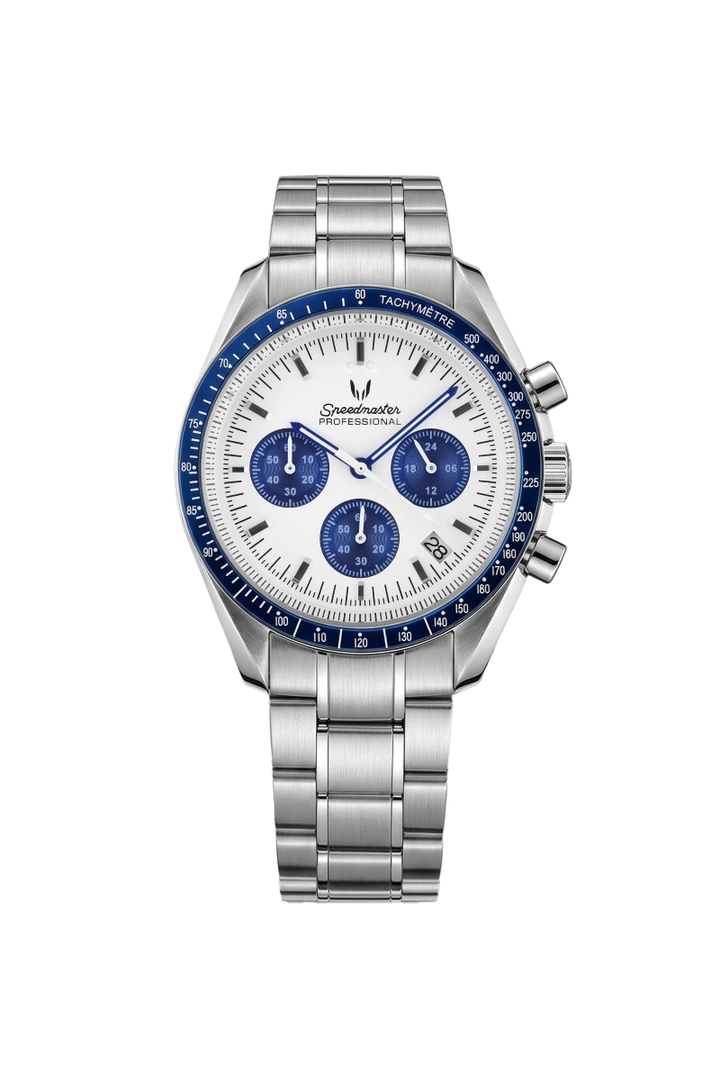
Custom Speedmaster Blue Panda
- 42mm case and compact 47mm lug-to-lug
- VK63 mecha-quartz chronograph
- 904L steel bracelet and ceramic bezel
$269.00
FAQ
Is a 42mm watch too big for a 7-inch wrist?
Not necessarily. Many seven-inch wrists can support 42mm, especially when the case has short curved lugs. Check lug-to-lug length and wrist width before deciding.
Can a 6.5-inch wrist wear a 42mm watch?
Sometimes, but 39mm is usually the safer choice. A compact 42mm case may work if its lugs remain within the wrist and the watch is not excessively thick or heavy.
Is 39mm or 42mm better for everyday wear?
For most people, 39mm is easier for everyday wear because it is usually lighter, more discreet, and more compatible with sleeves. Choose 42mm when you specifically prefer greater presence.
Does a 3mm difference in watch size matter?
Yes. Moving from 39mm to 42mm changes frontal case area by roughly 16% when simplified as two circles. Actual visual difference depends on the dial opening, bezel, lugs, and case shape.
What lug-to-lug length should a 42mm watch have?
There is no universal ideal. Many 42mm watches fall around 49-52mm, but a shorter span is easier on smaller wrists. The lugs should remain supported by the flat top of your wrist.
Do 42mm watches look more masculine?
No size has a gender. A 42mm watch looks larger and often sportier, while a 39mm watch looks more controlled. Masculinity is a marketing association, not a case measurement.


