
If your wrist measures 7.5 inches or more, start with watches around 40–44mm. For wrists over 8 inches, 42–46mm often provides stronger visual balance. A lug-to-lug length between 48mm and 54mm is a useful starting range.
Those numbers are not rules, though. The best watches for large wrists are not simply the biggest watches available. A good fit depends on wrist shape, lug design, case thickness, weight, and whether the strap is actually long enough.
I have seen 44mm watches sit beautifully on the wrist and 40mm watches feel awkward because of long, straight lugs. The complete shape matters more than a specs number.
What Is Considered a Large Wrist?

(Source: www.youtube.com/watch?v=UJYLr-ixbKU)
There is no official watch-industry definition of a large wrist. For shopping purposes, however, the following ranges are useful:
| Wrist Circumference | Practical Description |
|---|---|
| 7–7.5 inches | Medium to moderately large |
| 7.5–8 inches | Large |
| 8–8.5 inches | Very large |
| Over 8.5 inches | Extra large |
Measure the wrist where you normally wear your watch. Keep the tape snug against the skin without pulling it tight.
Circumference does not tell the whole story. Two people can both have an 8-inch wrist while having very different wrist shapes.
A wide, flat wrist usually supports longer cases well. A rounder wrist with the same circumference may need shorter, more curved lugs to keep the watch stable.
What Watch Size Works Best for a Large Wrist?
| Wrist Size | Useful Case Range | Typical Lug-to-Lug Range |
|---|---|---|
| 7–7.5 inches | 39–43mm | 46–51mm |
| 7.5–8 inches | 40–44mm | 48–52mm |
| 8–8.5 inches | 42–46mm | 50–54mm |
| Over 8.5 inches | 43–48mm+ | 52–56mm |
These ranges should change with the type of watch.
A 42mm dress watch can look very large because its dial extends close to the edge of the case. A 44mm dive watch may look more compact because its thick bezel reduces the visible dial area.
If you want a broader explanation of diameter, thickness, and case length, use this watch size guide before choosing a specific model.
Why Does Lug-to-Lug Matter on a Large Wrist?
Lug-to-lug is the total distance from the upper lug tip to the lower lug tip. It controls how much of the top of your wrist the watch covers.
Large wrists can usually support a longer lug-to-lug measurement, but longer is not automatically better. The lugs should follow the wrist rather than float above it.
Long, straight lugs can make a 40mm watch wear surprisingly large. Short, downward-curving lugs may help a 44mm case feel more secure and comfortable.
Integrated bracelets require extra attention. Their first links may not fold straight down, increasing the effective length beyond the listed case measurement.
My practical test is simple: the watch should leave some visible wrist beyond the lugs, sit without rocking, and keep the crown away from the back of the hand.
Why Can Two 42mm Watches Look Completely Different?

(Source: www.youtube.com/watch?v=s8LYzorL2co)
Dial Size
A wide, open dial makes a watch appear larger. Minimalist three-hand watches often have more visual spread than chronographs of the same diameter.
Bezel Width
A thick dive bezel reduces the visible dial area. This is why many 42–44mm dive watches look balanced rather than oversized on medium and large wrists.
Case Shape
Square, cushion, and tonneau cases occupy more wrist space than round cases with the same listed width. A 42mm cushion case may have far more presence than a conventional 42mm round case.
Case Thickness
Thickness adds physical and visual weight. It also affects whether the watch stays centered or rolls toward the outside of the wrist.
A large wrist may support a thick watch better, but that does not make extra weight comfortable by default.
Dial Color
White, silver, and other light dials usually look larger than dark dials. A black dial with a black bezel often appears more compact.
These effects explain why a side-by-side size comparison is more useful than relying on diameter alone. Our 38mm vs. 42mm watch comparison explores that difference in more detail.
Which Watch Styles Suit Large Wrists?
You do not need to buy a dive watch just because you have a large wrist. Different categories can work, but they usually need different proportions.

(Source: www.youtube.com/watch?v=qBZBH8cPlsA)
Everyday Watches
A 40–43mm three-hand watch provides enough presence without becoming tiring. Moderate thickness and curved lugs matter more than extreme diameter.
For an everyday watch, I would rather have a comfortable 42mm case than a heavy 46mm case chosen only to fill space.
Dive Watches
Dive watches are usually the easiest category for large wrists. Their wide bezels, bold markers, and substantial straps look natural at 42–46mm.
Cushion-case divers can be especially comfortable because their short lugs keep the case contained.
Chronographs
Chronographs often work well between 42mm and 45mm. Subdials, pushers, and tachymeter bezels reduce the visual size of the main dial, so the extra diameter has a purpose.
Pilot Watches
Traditional pilot watches use large dials and clear Arabic numerals for readability. Cases between 43mm and 47mm can look intentional rather than inflated.
Dress Watches
A dress watch does not need to be 44mm to suit a large wrist. A clean 39–42mm case will usually preserve the slim, restrained character that makes a dress watch useful.
Making a dress watch enormous can solve the size question while ruining the style.
Square and Cushion Watches
Do not judge these using round-watch diameter alone. Case length, corner shape, and bracelet articulation have a larger effect on fit.
Is Strap Length the Real Problem for Large Wrists?
A watch head may look excellent while the stock strap barely reaches the final hole. That is uncomfortable, looks unfinished, and leaves no room for wrist swelling in warm weather.
Before buying, check:
- The manufacturer’s maximum supported wrist circumference
- Whether a long or XL strap is available
- Whether a bracelet includes all removable links
- Whether additional links can be ordered
- Whether the clasp stays centered under the wrist
- Whether the first bracelet links fold downward
- Whether the strap uses a proprietary attachment
A leather strap should not live permanently on its final hole. Ideally, the buckle should close near the middle of the available holes.
Rubber straps can work well, but heavily pre-curved models may pinch a broad wrist. Nylon is easier to replace and adjust, although you still need to confirm its total usable length.
Tissot is unusually helpful here: its Chrono XL product information lists the lengths of both strap sections and even identifies an XL replacement strap for some variants. That is the kind of detail more brands should provide.
Which Watches Are Worth Considering for Large Wrists?
The following list covers several budgets and styles. It is not a parade of nearly identical oversized dive watches.
Casio G-Shock GM-5600B-1: Practical Digital Pick
The GM-5600B-1 measures 49.6mm long, 43.2mm wide, and 12.9mm thick. Its shape fills a broad wrist without depending on a huge round dial.
At 73 grams, it is also lighter than many steel sports watches. The resin strap and shock-resistant construction make it a sensible everyday option rather than a delicate display piece.
Citizen Promaster Dive BN0150-28E: Low-Maintenance Diver
This Citizen uses a 44mm case, 200 meters of water resistance, and an Eco-Drive movement powered by light. The polyurethane strap is listed at approximately 220mm long.
It is a practical choice for someone who wants a substantial watch without mechanical maintenance. The black dial and bezel keep the 44mm case from looking excessively wide.
Seiko Prospex SRPE93: Comfortable Cushion Case

(Source: seikowatches.com)
The SRPE93 has a 45mm case, yet its rounded cushion shape and contained lugs help it wear more comfortably than the diameter suggests.
It is 13.4mm thick, weighs 124 grams, and comes with a 22mm silicone strap. The design provides real wrist presence without relying on long projecting lugs.
SKYRIM WRIST Custom Speedmaster Fuji Redline: Accessible 42mm Chronograph

The Custom Speedmaster Fuji Redline offers a 42mm case, 47mm lug-to-lug length, and 12mm thickness. Those proportions provide presence without pushing into oversized territory.
Its nylon strap adjusts for wrists up to a listed 8.66 inches. The VK63 meca-quartz movement keeps it practical, while the ceramic tachymeter bezel and red accents give it a clear racing identity.
At 90 grams, it is also considerably lighter than many bracelet chronographs. For a large wrist that values comfort over raw mass, that is a useful combination.
Bulova Lunar Pilot 96K111: High-Presence Chronograph

(Source: www.bulova.com)
The current 96K111 version of the Lunar Pilot measures 43.5mm and uses a sapphire crystal with Bulova’s high-performance quartz chronograph movement.
Its long case and broad dial give it more presence than the diameter alone suggests. This is a better choice for someone who actively wants a noticeable chronograph rather than a quiet daily watch.
Tissot Chrono XL: Slimmer Than Its Diameter Suggests

(Source: www.tissotwatches.com)
The Chrono XL has a 45mm diameter but is only about 11mm thick. The leather version weighs roughly 75–79 grams, depending on the reference.
That combination is useful on a large wrist: broad visual coverage without the weight of a large steel dive watch. Its sapphire crystal and 100-meter water resistance also make it practical for regular wear.
Hamilton Khaki Aviation Pilot Pioneer Mechanical 43mm: Pilot-Watch Character

The Hamilton Pilot Pioneer Mechanical uses a 43mm case and a clear military-inspired dial. Its size belongs naturally to the pilot-watch design rather than feeling enlarged for marketing.
It is a good alternative for someone who wants a large watch without a dive bezel or crowded chronograph layout. Keep in mind that the hand-wound movement adds a daily ritual that not every buyer will enjoy.
Longines Master Collection 42mm: Dressier Option

(Source: www.longines.com)
Large wrists do not have to settle for bulky sports watches. The Longines Master Collection is available in a 42mm automatic configuration that provides more dial presence while retaining a traditional round dress-watch design.
It is a useful reference point for buyers who find 38–40mm dress watches visually too quiet but do not want a 45mm sports case.
Sinn U1: Serious 44mm Tool Watch
The Sinn U1 measures 44mm wide and 14.7mm thick. The case alone weighs 113 grams before the strap or bracelet is added.
It is a serious tool watch built from German Submarine Steel, with 1,000-meter pressure resistance and a crown positioned at four o’clock. That crown placement helps reduce pressure against the back of the hand.
This is not the option I would choose for light office wear. It makes more sense for someone who genuinely enjoys the weight and purpose of a substantial dive watch.
Panerai Luminor Marina 44mm: Luxury Statement Pick

(Source: www.panerai.com)
The 44mm Luminor Marina is one of the clearest examples of a large watch whose size belongs to its identity. Its cushion case, wide dial, and crown-protecting bridge create strong visual presence.
The current steel PAM03323 weighs 186 grams on its bracelet, while the titanium PAM03325 weighs 102 grams and includes leather and rubber straps. Those two versions show why material matters as much as diameter.
Can a Large Wrist Wear a 36mm or 38mm Watch?
Yes. It will simply create a different effect.
A 36mm or 38mm watch on an 8-inch wrist looks discreet, traditional, or vintage-inspired. It will not fill the wrist like a modern dive watch, but that may be exactly the point.
Small dress watches are usually easier to wear this way than small sports watches. Their restraint already belongs to the design.
A metal bracelet can add visual width, while a light dial can make a compact case appear more present. Rectangular watches may also cover more wrist than their listed width suggests.
I would not buy a tiny watch merely because small watches are fashionable. I would buy one because I liked the specific look. Large wrists give you room to wear large watches, not an obligation to do so.
How Should You Test a Watch on a Large Wrist?
Do not make the decision from a close-up phone photo. Wide-angle phone cameras often make the watch look larger than it appears from a normal distance.
Use this test instead:
- Look at the watch in a mirror from several feet away.
- Confirm that the lugs follow the top of the wrist.
- Rotate your hand and check whether the crown digs into it.
- Make sure the watch does not roll toward the outside of the wrist.
- Check that the clasp sits near the center underneath.
- Wear it for at least five minutes before judging the weight.
- Test it under your usual shirt or jacket cuff.
My Practical Recommendation
For a large wrist, I would start around 42mm for a sports watch and 40mm for a clean everyday watch.
I would move toward 45–48mm only when the design benefits from the size. Pilot watches, dive watches, and chronographs often do. A plain three-hand watch may not.
Most importantly, I would check the strap before falling in love with the case. An excellent 44mm watch on a strap that barely closes is still the wrong fit.
Watches for This Article

Custom Speedmaster Grey Mist — $259
- 42mm case and 47mm lug-to-lug
- Lightweight 90-gram construction
- Adjustable rubber strap for wrists up to 8.66 inches

Custom Speedmaster Fuji Redline — $255
- 42mm racing-style chronograph case
- Lightweight and adjustable nylon strap
- VK63 meca-quartz movement and ceramic bezel
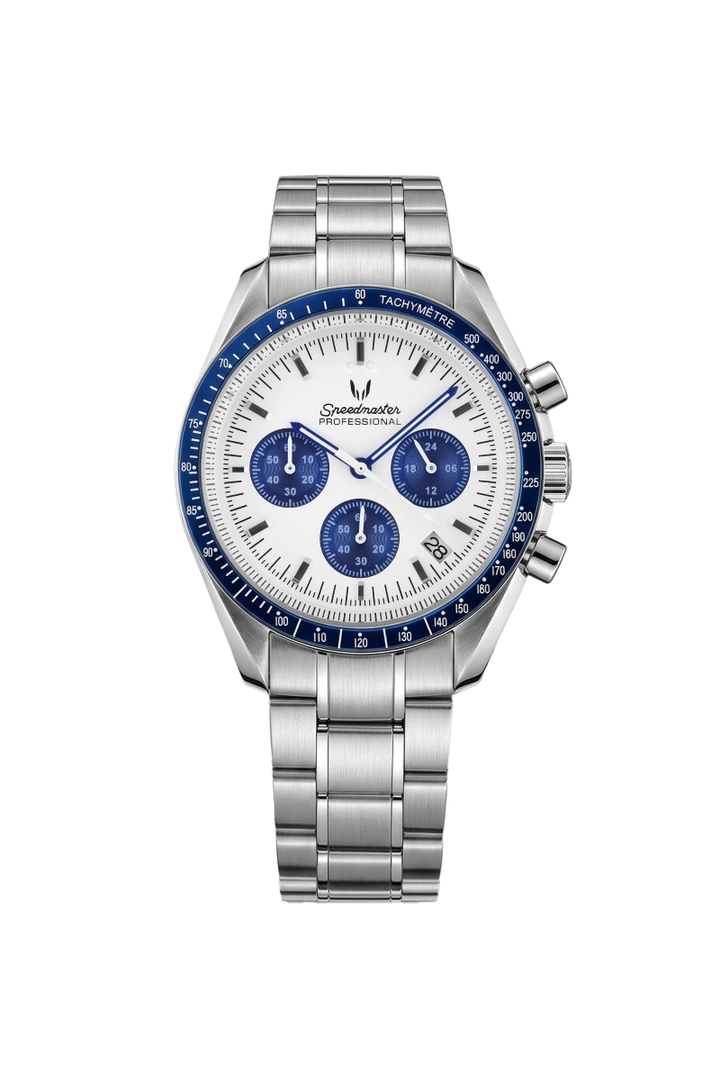
Custom Speedmaster Blue Panda — $259
- 42mm case with a 47mm lug-to-lug length
- 904L stainless steel Speedmaster-style bracelet
- Blue panda dial with VK63 chronograph movement
FAQ
What watch size is best for a large wrist?
For wrists measuring 7.5 inches or more, 40–44mm is a useful starting range. Wrist shape and watch style may move that range in either direction.
Is an 8-inch wrist considered large?
Yes. In practical watch-sizing terms, an 8-inch wrist is large and can usually support longer and wider cases comfortably.
Is a 42mm watch big enough for an 8-inch wrist?
Usually, yes. A 42mm sports watch often looks balanced on an 8-inch wrist, especially if it has a broad dial or substantial bracelet.
Can a large wrist wear a 38mm watch?
Yes. A 38mm watch will create a restrained or vintage-inspired look rather than a bold modern one.
What lug-to-lug size works for large wrists?
Approximately 48–54mm works for many large wrists. Flat wrist width and lug curvature still need to be considered.
How do I know whether a watch strap will fit?
Check the maximum listed wrist circumference or total usable strap length. For bracelets, confirm that all removable links are included and that extra links are available.
Are dive watches better for large wrists?
They are often easier to size because many dive watches use 42–46mm cases, wide bezels, and substantial straps. They are not the only suitable option.
What watch shape looks best on a wide wrist?
Round, cushion, square, and tonneau cases can all work. Cushion and square cases usually occupy more visual space than round cases of the same listed width.
Should a watch cover the entire top of the wrist?
Not necessarily. Some visible wrist beyond the case usually creates better balance. The lugs should not look lost in the center or spread awkwardly across the edges.
Are heavy watches more comfortable on large wrists?
Not automatically. A large wrist may distribute weight better, but case shape, strap flexibility, and clasp position still determine comfort.


